/* jquery */ /* jquery accordion style*/ /* jquery init */
Showing posts with label Book Reviews. Show all posts

Getting Started with the micro:bit book review

Goal of this book is to deliver a practical introductory guide to microcontrollers, how they work and how to extend their functionality using electronic circuits and code.

The educational theme is accentuated by:
• easy-to-follow step-by-step instructions
• full colour images and diagrams
• fully explained code examples - with coloured syntax
• electronic circuit diagrams
• electronics theory plus example calculations
• topic-specific ‘Going Further’ challenges
• end-of-chapter quizzes (with end-of-book answers)

The first chapter is a basic introduction into the microbit board, its component, control capabilities and interfacing to external devices.

While chapter two introduces basic coding techniques using the popular web-based Microsoft block editor.

The next three chapters offer more advanced coding examples, including controlling the LED display, A and B button interaction, creating programs with loops and decision logic.

The remaining chapters dig a little deeper into digital and analog I/O, with real-world project examples such as detecting battery level, temperature and movement.

Free micro:bit MicroPython Coding Tutorials

Raspberry Pi in Easy Steps - Book Review

The ‘Easy Steps’ books are well known for their excellent layout, clear and concise text and easy-to-follow instructions. It’s a format that ensures this Raspberry Pi in Easy Steps book is a great choice for anyone beginning their Raspberry Pi journey.

Inside author Mike McGrath kicks off with a basic introduction to the Pi. You’ll become familiar with the board’s components, the startup and login process, the graphical desktop and the underlying file system. An overview of the Linux command line completes this section.

The rest of the book is devoted to writing code. As a gentle start it begins with the Scratch language, where you’ll snap-together various blocks to build event-based animations using its stage, sprites, costumes and sounds.

All the remaining sections focus on the far more flexible Python language. Topics include the Python command-line interpreter, data structures (lists, tuples, sets and dictionaries), loops, functions, modules and file I/O. Then it moves on to building simple games with the pygame module and creating tkinter GUI apps. Lastly, there’s a short introduction to interfacing with the Pi board's GPIO pins.

In summary this book is an excellent introduction to Raspberry Pi coding. Follow the steps all the way through and you’ll be in a position to tackle a wide range of Python coding projects. And remember, the Python language is also available for Windows, macOS and most other Linux platforms.

My Free Raspberry Pi Python Coding Tutorials

Creative Projects with the Raspberry Pi - Book Review

The aim of the Creative Projects with the Raspberry Pi book by Kirsten Kearney and Will Freeman is to inspire readers to build electronic projects with the Raspberry Pi 3 and Zero W. In total there are 35 different projects to build, across topics such as robots, games, home automation, scientific experiments and art.

Beginners can start with the basic building projects, such as a classic LED switching circuit and a Raspberry Pi power button. These only need a breadboard and a few simple components. And the project code is from the publisher's book's webpages.

However, there is no getting away from the fact that the core of this book revolves around relatively sophisticated, and in a number of cases extremely involved, electronic Pi-powered contraptions.

In other words, it's aimed at serious hardware hackers, rather those who simply wanting to tinker around with Raspberry Pi electronics.

While one or two projects can be done in a few hours, many will take much longer to construct. In fact, for a few the timespan is measured in weeks. So you’ll need plenty of patience, a solid soldering technique plus an assortment of DIY skills.

And you’ll need deep pockets too. When you take into account all the additional components, such as an LCD screen, various add-on boards and experimental kits like the CamJam EduKit 3, the majority of projects cost considerably more than a Raspberry Pi 3. The most advanced projects can cost thousands of pounds.

In summary, it’s a book stuffed full of innovative and well documented ideas. And you can of course take these ideas and develop you own custom variations. But if you're just taking the first steps of a journey into Raspberry Pi hardware hacking, or your time and funds are limited, it probably isn’t the right book for you.

Try my Free Raspberry Pi Python Coding Tutorials


Land of Lisp by Conrad Barski

Over the last few years there's been a strong resurgence in the functional programming paradigm. New languages such as Clojure and Scala, which synthesise functional features with a modern-looking syntax, have engendered enthusiastic communities. While JavaScript, CoffeeScript and TypeScript developers increasingly want to code in a functional style.


Understanding key functional concepts is widely considered to be an essential part of a software programmer's skill set. One which invariably results in higher levels of proficiency with other languages.


However, anyone who has tried their hand at functional programming knows it necessitates a different way of thinking. This mindset shift invariably takes some time to accomplish. Many give up before the proverbial light bulb is illuminated.

What would help is an engaging and entertaining introduction to functional programming. Land of Lisp aims to provide just such a solution.

It’s a comprehensive 500 page guide which covers the full breadth of functional programming topics, from using simple lists to defining your own macros. Throughout exercises and code examples are practical in nature, with an underlying gaming theme.

The author's informal style, combined with a fluid pace, well structured content and those wacky-yet-informative illustrations, are a breath of fresh air in the often insular world of functional programming.

Although the book’s content and code listings are based around CLISP (an ANSI Common Lisp implementation), the lessons learned can be applied to other Lisp dialects, or languages that support a functional style of coding.


The question is whether this book succeeds in easing the path to functional programming mastery? I think it does.

Inside Steve's Brain by Leander Kahney

The appeal of this multi-faceted book extends to marketing folks, product designers, budding entrepreneurs and anyone curious about how Apple came to be the most valued company in the world.

It works as a narrative on Apple's history, with an extended timeline compared with rival books, and includes a detailed look at the formation of Pixar and it's day-to-day activities. Historical information is blended with analysis of the single-minded focus, marketing methods, design practices and perfectionist approach that made Apple the company it is today.

Threaded throughout are tales of the man himself and how he shaped the company right from the very beginning. While it certainly isn't intended to be chronological biographical study of Jobs, it is nevertheless full of interesting facts and anecdotes.

His religious devotion to perfection is evident in every chapter. Examples include boxing of the original Macintosh in 1984, meticulous attention to screw heads, precise lighting arrangements for Apple's onstage announcements and the internal layout of the high-street stores.

Of course, Jobs needed a world-class team of people around him to achieve such great things. Each individual was invariably handpicked, lured by Jobs's vision and cajoled by his undoubted charm. Yet they needed to share his passion, adjust to his individualistic work practices, weather his fierce outbursts, cope with his often overbearing attention to detail, and handle the relentless pressure to deliver nothing less than perfection.

The book's smooth narrative style and flow makes for an enjoyable read. Nevertheless, I'd like to have seen more insights from Jobs himself. The majority of the views expressed come from employees and associates, which aren't the same as listening in on his own thoughts. In addition, the reverence given to Jobs and his methods means we miss out on a more balanced view of what it was really like to work for one of the most influential characters of the computing age.

Read more Apple analysis posts.

Enterprise Games by Michael Hugos

In fitting with the subject matter this book has a lively, engaging and conversational delivery. In structure it's loosely divided into three parts.

Part one addresses the business-centric application and potential of what Hugos refers to as Game Mechanics. It stresses the need for game-like goals and rules, real-time feedback, player engagement and generating a desire to participate. Here you'll find a succession of insightful thoughts and challenges to the status quo of business operations.

The second and third sections are filled with examples to illustrate Game Dynamics in action. Examples as divergent as multi-player online games, social media, mobile apps, 3D animation and visual data analytics. These sections are quite similar in form, with the latter focusing more on the social implications.

Is the book an informative and thought provoking guide to Game Mechanics? Yes it is. Does the book contain examples of how specific companies employ Game Mechanics today to attract, engage and motivate your customers or employees? Absolutely.

However, this book doesn't answer the puzzle of how to implement Game Mechanics inside your own organisation. It's left to the reader to find their own path within the gaming framework. Such a description isn't really possible. After all, there are so many routes to take, so many options to explore, there isn't one simple formula that will work for every organisation. A positive book in nature, the optimistic highroad focus means it doesn't really explore the potential drawbacks and consequences of a game-centric approach.

The world of Game Mechanics is at an embryonic stage. Enterprise Games is a comprehensive and accomplished entry point to exploring this new world. In the coming years it will be interesting to see who's had the foresight, bravery and determination to make it work.

Terminal World by Alastair Reynolds

Dividing a world into mysterious zones is an inspired storytelling concept. The conditions in each zone dictate the type of technology that can be employed, and anyone crossing a zone boundary will suffer from physical distress. It all leads to considerable intrigue and tension as the main characters, Quillon and Meroka, undertake their long journey.

The zonal constraints impart a distinctly steampunk feel, with horses, airships and various steam power contraptions making regular appearances. Each zone tends to have its own collection of inhabitants. Although largely humanoid they often exhibit divergent evolutionary traits, including enigmatic Angels and dark-souled Skullboys. The grotesquely memorable Carnivorgs are an exception.

I found the book both entertaining and easy to read, but it might not appeal to everyone. Some may be unhappy that many certain key aspects are never fully explained. For example the source, number and extent of the zones, or the origins, capabilities and evolutionary map of its humanoid inhabitants. Plot lines are sometimes left hanging in a wait-for-the-sequel type fashion - especially the ending. Yet, as there is no sequel, some readers may feel shortchanged with this approach.

Of course, just as in real life, a fictional book doesn't have to provide all the answers. As a writer, hanging story lines simply stir my imagination. And, in the end, I found this book had a distinctly different feel to other SF books I've read. A good thing in my opinion.

Win-Win Selling by Wilson Learning Library

Selling isn't an easy profession. In a rapidly changing world with increasingly savvy consumers, the techniques that worked yesterday might not succeed tomorrow.

The approach discussed by Win-Win Selling takes the well known needs-fulfilment salesman scenario and extends it to the 'counselor evolution' model. This model is all about creating a close relationship, or even longterm partnership, between the salesman and the customer.

There are four main sections, namely Relating, Discovering, Advocating and Supporting. The overall aim is to encourage a more customer friendly approach by changing attitudes, rather than imposing a rigidly defined structure. While the primary audience is sales professionals, there's plenty of thought provoking information for anyone connected to sales, marketing or advertising.

Throughout it emphasises the importance of honesty, credibility, competence, and in particular empathy. Empathy is essential to discover your customers attitudes, motivations and feelings, understand their problems and develop a strong, trusting relationship. In this way a successful salesman will identify and fill the gap between the customers current needs and their desired solution.

Once learnt the basic 'relationship' selling principles can be used to form the basis of your own bespoke technique. In fact, the book positively encourages the reader to pursue their own style and best practices based on the information provided.

It would have been easy to create just another 'theory' book. Instead the reader will enjoy a practical style of presentation, one where advice is backed up with a raft of stories and case histories, which clarify the messages and illustrate how they work in real-world situations. My only niggle is the occasionally disjointed layout and flow.

In a crowded marketplace Wilson Learning have created a distinctly individual book that's as easy to read as it is informative. And one that successfully conveys a better way to sell.

Home Truths (Novella) by David Lodge

Create a stage play script. Develop it during the rehearsal stage. Watch it being performed. Then turn it into a prose fiction novella.

Certainly not your typical fiction book journey, however, in the skilful hands of Lodge the result is a delightful little book.

Throughout the narrative I was constantly aware of a stage-like influence. In my mind's eye I could easily visualise how the set would appear to the audience, 'watch' a new character take to the stage and 'see' the dialogue performed. I could even anticipate the audience laughter.

How much of this was down to prior knowledge of how the book was conceived, the image on the cover, or the actual content was difficult to ascertain.

David Lodge isn't afraid to experiment with composition, style and voice. It's one of the primary reason I enjoy reading his novels so much. In the 'Afterword' section of the Home Truths novella Lodge asks the reader to judge if process 'works'. This reader say it does, brilliantly.

Write To Sell by Andy Maslen

Write to Sell is a focussed, content-rich guide to the craft of copywriting. Maslen's highly regarded experience, knowledge and skills really shine through the pages.

I particularly liked the book's format. No padding waffle, no excessive repeating of points and advice, no drifting into marketing mode. Just richly-packed pages with masses of relevant, plainly stated and insightful information.

Split into six sections, the first three aim to clarify and focus the reader's thinking, and encourage them to view things from the buyer's perspective. The last three sections guide the reader through copy generation. It's an easy and engrossing read from cover-to-cover. However, the clear layout, numerous summaries and abundance of tips also make for a great reference book.

I think Maslen has created a gem. The techniques, advice and tips are applicable to reporting, presentations and writing in general. As a source of inspiration and advice it's become a constant companion in my copywriter activities - which says it all really.

Links: Andy Maslen's Sunfish company website

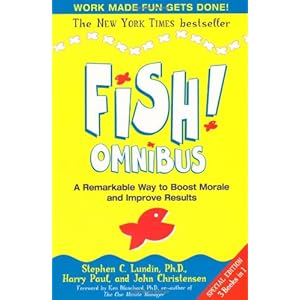
Fish! Omnibus by Steve Lundin, John Christensen, Harry Paul and Philip Strand

We'd all love to have a positive, energetic and happy work environment. For the authors of Fish! this is not only possible, but something we can control.

This omnibus edition combines the original Fish! book with Fish! Tales and Fish! Sticks. The supplementary books take the fishmonger-inspired philosophy and reinforce it with real-world examples and motivational suggestions respectively. Each book is quite short in length, so it's possible to whiz through one in a couple of lunchtime reading sessions.

Fish! imparts its wisdom using a story. Yes, it's a highly Americanised and somewhat corny story, an approach that won't suit everyone. Nevertheless, it's quite easy to spin through the text and draw out the salient points. And what are these salient points? Well, it boils down to four key messages: attitude, playfulness, goodwill and presentness.

Your own attitude is probably the most important factor of all. How you feel about the day, how you respond in different environments and situations, and your relationship with others; it's all under your control. You can be positive, energetic, creative, patient, caring and supportive. Or you can decide to be bored, disinterested, regretful, bitter, hostile or angry. Essentially the message is become whoever you want to be simply by changing your attitude.

Treating every task as a play activity can't fail to engender a sense of fun and enjoyment. Once again it's just a matter of personal perspective and attitude. The authors suggest that even the most serious and demanding tasks can be viewed in a playful light. Though I'm certain transforming some of your most obnoxious chores into amusing entertainment will require more than a little effort.

How does it feel to make someone else's day? Energising? Satisfying? Good deeds invariably bring about good feelings. Money and success, on the other hand, tend to bestow far less in terms of personal gratification. The message here is when you offer your time, assistance, feedback and support, your own happiness levels increase.

Busy lives, weighty responsibilities and relentless deadlines are difficult enough. However, beating yourself up about past events or worrying about what will happen tomorrow, only makes coping with today that much harder. So, the final key message is be present; live in the moment. The past cannot be changed. The future is yet to happen, and often turns out to be strikingly different to what we'd imagined. It's notable how many individuals, when questioned late in life, say what they regret most of all is the time they spent worrying about situations and events that never actually happened.

Of course, you can apply the Fish! philosophy to any aspect of life. A simple recipe to create a happier you.

Beyond Bullet Points (3rd Edition) by Cliff Atkinson

Ever witnessed a slide presentation without bullet points? No? I can't remember one either. Yet, all too often this de facto standard of presentation acts as an aide-memoire for the presenter, rather than a compelling story for the audience.

The aim of Cliff Atkinson's book is to banish bullet points and text-dominated slides. His mission is to encourage you to create a very different kind of presentation. One that engages the audience with a well crafted, highly focussed, carefully ordered collection of headlines and images. A collection that delivers a story rather than a lecture. As the subtitle suggests he wants you to "create presentations that inform, motivate and inspire."

To compose a successful presentation the Beyond Bullet Points (BBP) approach takes cues from other mediums, namely stage plays, newspapers and movies. As with a stage play, a successful story flow will have three acts; a beginning, a middle and an end. Each slide has the kind of strong, memorable headline you'd find in a newspaper. And the complete slide collection is designed in a movie-style storyboard manner.

Fittingly, the book begins with a BBP success story, and by the end of chapter three you'll have acquired a solid overview of the steps required. At this point many readers may want to head off and apply their new found knowledge immediately. However tempting this might be, only by reading the rest of the book will you discover many valuable nuances, and learn how to avoid some of the more common mistakes.

Content organisation is excellent, with a smooth transition from chapter to chapter. More advanced information and reference material is relegated to one of the five appendixes, rather than clutter up the book's main flow. As you'd hope with a book focussed on presentation, the page layout and general styling is clear and effective. Nevertheless, with the PDF version there is an occasional problem with text contrast, the result of some poor colour choices; namely black-text-on-dark-grey and white-text-on-light-grey. Although no such problems on my Kobo Touch e-reader.

The book's website has a number of very useful downloadable resources, including toolkits and templates for a range of Microsoft Powerpoint products (2003 to 2010).

I believe this book will help anyone create better presentations. Whether you create them as part of your job, or as an ad hoc activity for work, clubs or social groups, I heartily recommend it.

The Art of SEO by Eric Enge, Stephan Spencer, Jessie Stricchiolla and Rank Fishkin

Search Engine Optimisation (SEO) has a reputation of being a rather mysterious, even clandestine practice. The aim of this book is to lift the lid on this art form.

The book's four authors are highly active in the SEO field and have associations with organisations such as the Search Engine Marketing Professional Organization (SEMPO), Stone Temple Consulting, Netconcepts, Science of SEO and SEOmoz. This high-powered meld of business intelligence, technical knowledge and practical expertise has the potential to deliver a rich reading experience.

So, I already had high expectations as I started to work my way through the book. A glance at the table of contents hints at a meticulous eye for detail and comprehensive approach. After reading each subsequent chapter this feeling is only intensified. The tactics and methodology covered range from straightforward but essential SEO information to deep, sophisticated insights aimed at the advanced practitioner.

Subjects discussed include search engine theory and behaviour, key analytical tools, the impact of social media, user-focussed data, effective website creation, result tracking, SEO best practices and much more. The text is full of links to relevant organisations, in-depth reports, appropriate industry analysis and case-in-point websites. In addition the content is supported by a website, artofseo.com, which contains content updates plus hands-on resources and guides.

The authors also found space to include a chapter on the merits of whether to build an in-house SEO team or outsource the operation. At over 30 pages this chapter is just as comprehensive as any other topic, and of significant value to any manager responsible for delivering a high quality SEO solution.

Despite the detailed coverage I found the material easy to read and understand. My relatively limited SEO knowledge didn't allow me to verify the accuracy or fine-grained quality of much of the book's material. However, I can say my own SEO knowledge was greatly enhanced by this book.

In conclusion I feel The Art of SEO is an absorbing read for anyone interested in SEO, and a book that will become a well-thumbed encyclopaedic reference for practitioners. As the authors note in their final chapter, SEO is an evolving art form, so it's obviously difficult to write a truly definitive book. Yet, I feel the Art of SEO is as close as you'll find anywhere.

After all, in today's marketplace taking full advantage of search technology can be the difference between a dominant success story and a business failure.

The Case of the Missing Books by Ian Sansom

Ian Sansom's 'The Case of the Missing Books' is the first in his 'The Mobile Library' series, which includes 'Mr Dixon Disappears', 'The Book Stops Here', 'The Bad Book Affair' and 'The Delegates' Choice'.

The early pages are largely dedicated to introducing the central character, Israel Armstrong. This resoundingly individual, richly eccentric librarian is the source for most of the narrative's social interplay, zany adventures and bizarre incidents. Indeed, while this is in essence a detective story, Israel is one of the most unconvincing sleuths you're ever likely to encounter. Hence all the fun.

Israel's new job in Northern Ireland is a far cry from his normal London stomping ground, lifestyle and routine. This alienation from the familiar and comfortable only accentuates his highly individual character traits.

The levels of intrigue and secrecy run deep in the close-knit Tumdrum and District community. It's colourful characters - no doubt drawn from Sansom's astute observations of the County Antrim area's real life inhabitants - are vividly brought to life by the author's considerable writing talent and deft style.

My only niggles are a rather slow beginning and that certain comic dialogue passages, written in a halting, leading-nowhere conversational form, might be easier to listen to rather than to read. Nevertheless, I found it a highly entertaining book. I'll certainly be seeking out the rest of the series.

Microsoft Excel 2010 Formulas and Functions Inside Out by By Egbert Jeschke, Helmut Reinke, Sara Unverhau, Eckehard Pfeifer, Bodo Fienitz, Jens Bock

There's plenty of books on the subject of Excel, so I was interested to see how Microsoft Excel 2010 Formulas and Functions Inside Out would fare in such competition. Weighing in at 1088 pages, and split into four sections, it certainly falls into the comprehensive reference category.

In the first section a problem solving approach offers a speedy orientation to some of Excel's most useful formulas and functions. The many insights, tips and tricks also whet the appetite for what's to come.

The second section lifts functions out from the worksheet cells, and spotlights how they can be used within macros to deliver more sophisticated programming solutions. It's a good place to discover new concepts and ideas. Many of these solutions also include visual and charting scenarios, plus there's an introduction to creating custom functions with Excel's built-in Visual Basic for Applications (VBA) development tools.

In both these sections the content is attractively presented in a practical step-by-step flow. Most pages have at least one colourful image, figure or table. The text is further supplemented by plenty of embedded boxes containing notes, tips, associated information and references to sample files. It's a presentation style that lends itself to the experimental approach, rather than a long reading session.

Although not strictly in the formula and function domain, the authors have also thrown in examples of the new PowerPivot in action. A feature I'm sure will be heavily utilised by 2010 edition owners.

Section three is dedicated to in-depth function explanations, suitably organised into category-specific chapters. Despite the technical nature of the content, even here there's no shortage of colourful graphics and informative boxes.

And finally, the appendixes contain the obligatory function lists in A-Z and category arranged format, plus a summary of the features new to Excel 2010.

The comprehensive nature of this reference is further enhanced by a suitably large collection of downloadable sample files. These samples are fully cross referenced by chapter usage at the front of the book.

In conclusion this book is a strong product in this competitive marketplace. It's certainly a book I could recommend to anyone with a basic understanding of Excel and a desire to dig deeper into its potential. And despite being aimed at Excel 2010, there's still a great deal of value for 2003 and 2007 version users.

Gardens Of The Sun by Paul McAuley

This book is the sequel to The Quiet War. Having thoroughly enjoyed that book I expected great things from this novel. And I wasn't disappointed.

There's a smooth transition from the first book to the second. In fact, there are so many references to Quiet War characters, events and story lines, I can only encourage everyone to read that novel first. After all, it's an excellent book.

Once again, I found my imagination stimulated by the richly described gene-engineered gardens. Spectacular habitats created by gene wizard Avernus and Sri Hong-Owen (Sri is Avernus's biggest admirer and would-be successor). These passages endow a convincing sense of realism, no doubt greatly helped by McAuley's Botany Ph.D, research activities and lecturing experience.

Yet I'm also impressed by McAuley's ability to craft a rich collection of three-dimensional characters, high-quality dialogue and any number of fully believable scenes - whether they be on Earth, the Moon or within the gas giant systems of Jupiter, Saturn and Neptune. When combined with its great sense of pace and fast moving plot, I found the 439 pages simply whizz by.

The only low point for me was the weak penultimate chapter. It exhibited such a different voice, style and pace, I had to wonder if it was written by the same person. But it couldn't spoil my enjoyment of the book as a whole.

There are more of Paul McAuley's words at his unlikely worlds blog site.

Breaking The Page by Peter Meyers

This guide to the embryonic world of electronic books is full of observations, ideas and suggestions. It discusses the ebooks of today, their capabilities, relative immaturity and shortcomings. And it hints at the ebooks we might own tomorrow, ones based upon innovative approaches, designs and techniques.

Even in this shortened three chapter preview edition, there are rich veins of information to be discovered. With plenty of useful material for anyone interested in the future of ebook creation and publication. Subjects covered include effective navigation, table of contents integration and the true purpose of indexes.

Peter Mayers makes the case that ebooks shouldn't try to slavishly copy the best features of our printed books, but instead replicate the actual experience of a physical book. Something that can be achieved with carefully considered, reader-focussed design. Certainly not an easy trick to pull off, but essential to realise the ebook's inherent advantages and rich potential.

There are so many topics to consider. Content scanning, intelligent searching, intuitive gestures, smart hyperlinks, interactive material, even user-defined flow - all unobtrusively combined with uncluttered readability.

Peter exploits his extensive publishing industry experience, knowledge and contacts to deliver a collection of interesting and up-to-date examples. Examples that are carefully chosen to highlight both good and bad practices. Examples that encompass competing technologies, such as EPUB, MOBI, HTML5 and apps. Examples that work for basic electronic ink screen e-readers, and ones aimed at the latest multifunctional tablets with their full colour displays.

We are just the beginning a journey towards building a better ebook. It's far from obvious which initiatives will be ultimately successful, and there'll be many failures along the way. I'd suggest that thoughtful, elegant and purposeful ebook design, is more likely to succeed over any particular technical standard, file format or technology. But it will certainly be a fascinating journey.

The full version of this book promises to help illuminate this journey. And I for one can't wait to read it.

(Here's a few innovative ebook company websites: Inkling, Touch Press.)

One Click by Richard L.Brandt

The Amazon effect. Hard to ignore. It's already led to significant changes on our local high streets. Bookshops have almost vanished, and those that remain struggle for profits. Pavement footfall on a cold winter's day has been replaced by mouse clicks by the fireside.

Richard Brandt's excellent book brings to life the story of Jeff Bezos - the man, the business executive and the visionary. And it explains in wonderful details how Amazon grew from the humblest of beginnings, to be mentioned in the same breath as Google and Apple.

There are fascinating insights into Bezos's early life. It's easy to see how his self-reliant, NASA-influenced, book-filled upbringing led to such high academic achievements and a love of technology. A boundless self belief helped sling shot him into a highflying executive career and ultimately to become one of the world's most influential entrepreneurs.

Yet, it was the early Internet, and its 2,300% yearly growth, that really caught his attention. A huge business opportunity just waiting to be tapped. The result was a classic US West Coast startup story, beginning as it did with a garage, one computer, two employees, a wife and a short course on book selling.

Amazon's stellar growth was only possible by forgoing all notion of profits, cutting non-essential costs, operating with a can-do attitude and attracting the right kind of investors. A strategy that resulted in a stock market floatation after only two years, those original $18 shares yielding a company valuation of $429 million. Only one year later the shares were $105, raising the valuation to in excess of $5 billion.

Despite the problems caused by the dotcom crash, Amazon expanded into CDs, DVDs, games and a host of other marketplaces - a trend that continues today with their wildly successful Kindle ebook devices. Yet, like any natural entrepreneur Bezos is always looking for the next big thing. The groundbreaking Amazon Web Services, which provide hosting services for a multitude of other companies (even some competitors), only confirms his impressive vision and boldness.

Amazon's phenomenal success, and his own billionaire status, has allowed Bezos to indulge in very personal projects. The Blue Origin company - with its aim of safe, affordable, commercial space flights - has its roots in those early childhood dreams of space exploration and NASA achievements.

On reading this book, it's clear the success of Amazon is down to Jeff Bezos's highly individual thinking, customer-obsessed focus, unconventional management style, unshakable self-belief and undoubted entrepreneurial skills - with an occasional slice of lady luck thrown in.

It's also clear Richard Brandt has the gift of conveying considerable amounts of information with splendid clarity, while maintaining a satisfying pace and sense of movement. I for one will be reading more of his work.

PHP & MySQL: The Missing Manual by Brett McLaughlin

Right from the start PHP & MySQL: The Missing Manual assumes the typical reader will have no knowledge of PHP or SQL. Instead it suggests they are likely to be an HTML, CSS and JavaScript programmer, wishing to explore server-side development. As such, at least a basic understanding of HTML is a prerequisite.

At close to 500 pages there's plenty of space to cover each new topic in detail. Detail that includes numerous images, code examples, tips, notes and advisory warnings. All supplemented with wise best practice advice and informative background information.

Despite the book's length a clean layout and bold page headers ensure flicking back and forward to specific areas of interest is undemanding and rapid. As the content is intended to be consumed in a practical, hands-on manner, it's good to find a complete set of code examples available for download at the Missing Manuals website.

Brett has a light and entertaining style of writing, which he combines with a gentle wit. New information is presented in a fluid and coherent manner, even when introducing some of the more complex topics.

Structurally the book's thirteen chapters are divided into four main sections. While each section has its own well defined domain, they join together to form a smooth, interactive journey. A journey to assemble real-world PHP and MySQL-based web pages from scratch.

The first section successfully guides you through the basics. As you'll have to download the necessary software, instructions are provided for both Microsoft Windows and Apple Mac. This is followed by a step-by-step overview of the PHP and SQL languages, and the MySQL database product.

Located in the middle two sections are numerous web page examples, each designed to explore a specific element of server-side development. By the end of these sections you'll have the knowledge to create key elements for a typical website, and be able to dynamically retrieve, display and manage database-stored content. Any page you've created can be subsequently modified to address your own design requirements.

Important topics such as error handling are not only included, but covered in some depth. And Brett doesn't shirk from the more complex areas, such as regular expressions and managing database blobs (binary objects). However, this book isn't intended to be a PHP or SQL language reference and doesn't attempt to cover object-oriented programming or other advanced PHP techniques.

The final section covers the creation of a secure user authentication page - another essential website element. It builds upon the knowledge learned in earlier chapters, while introducing new topics such as authentication headers, credential validation, encryption, cookies and user sessions.

In summary, if you're after an excellent, straightforward, yet comprehensive introduction to web server application development, this certainly hits the mark.

The Bad Beekeepers Club by Bill Turnbull

Does the thought of beekeeping arouse your inquisitive side? Then this may be the ideal book for you.

Inside is a series of lighthearted and amusing tales describing the ups and downs of gaining entry to the beekeepers club.

Along the way you'll discover a multitude of things you never knew about bees, bee-behaviour, swarms, hives, honey, wax, pollen and propolis - not to mention the mindset and endless paraphernalia of a totally smitten apiarist.

By the end you'll also know quite a bit about Bill himself, including his ability to balance family life with both a beekeeping obsession and a demanding role as a globe-trotting TV presenter.

Becoming a beekeeper isn't a journey for the faint-hearted, but one that requires dedication, commitment and a certain level of bravery. And, as the passion takes hold, it's a journey that demands ever growing amounts of time, money and garden shed space - not to mention considerable patience and understanding from other family members.

If you're looking for a step-by-step guide to beekeeping or an in-depth look at bee biology, it's not the book you need. But if you'd like to be entertained by a collection of captivating bee-related stories, I can heartily recommend this book.